


Cart
0
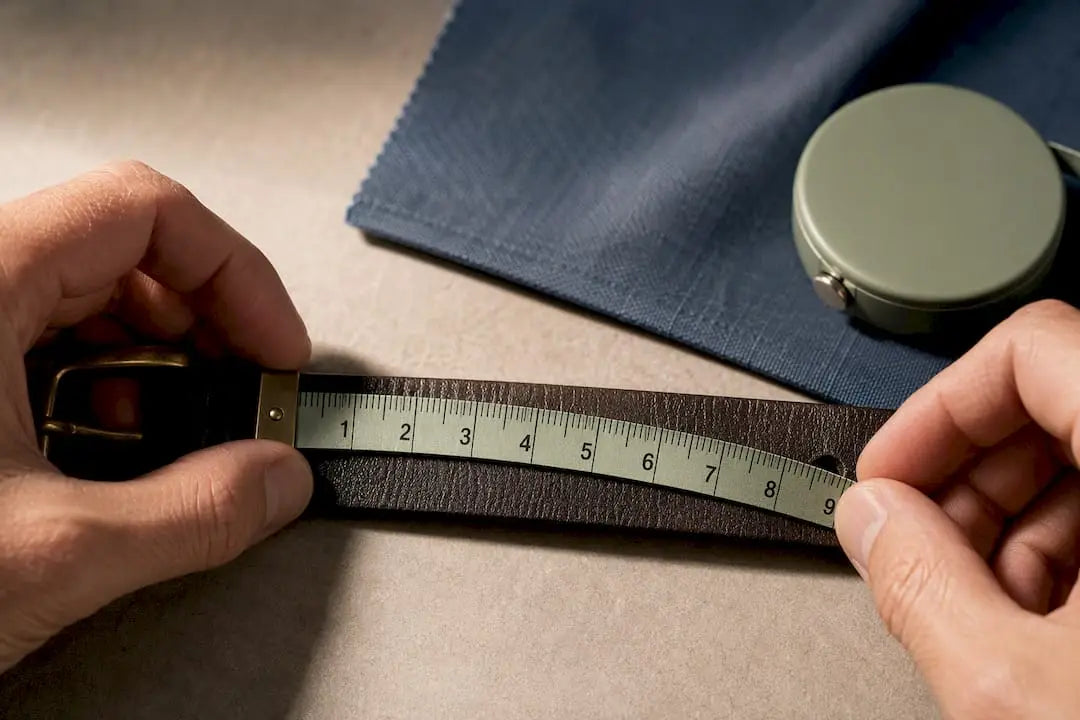
Measure where you actually wear the belt, at the belt loops, and that number in inches is your size. If you can’t measure directly, take your pants size and add two inches. If you’re checking a belt that already fits, measure from the buckle fold to the hole you use most. Round up when you’re stuck between two sizes.
TL;DR:
- Measure your belt loop height directly at the position where you wear your belt for the most accurate size, not over the waistband or natural waist.
- When using an existing belt, measure from the buckle fold to your most used hole, avoiding the buckle’s outer tip or the strap end to prevent overestimating size.
- For pin-buckle belts, order based on your waist measurement, rounding up if between sizes, while ratchet belts should be 6 to 8 inches longer than your waist, then trimmed after wear.
- Belt width should be 1 to 2 millimeters narrower than your trouser loops to ensure smooth clearance, with dress belts around 30-35 mm and casual or jeans belts about 38-40 mm.
- Always check the fit after arrival by fastening at the middle hole and ensuring the belt tail passes through the first keeper smoothly, adjusting with hole punches or trimming as needed.
Table of Contents
- How to Measure Your Body at the Belt Position
- How to Measure an Existing Belt That Fits
- Converting Your Measurement into a Purchase Size
- Belt Width and Style: Matching Loops and Outfit
- Checking the Fit Once the Belt Arrives
- Our Approach to Sizing Accuracy
- Different Sizing Standards Across Regions and Brands
- Adjusting Belt Size After Purchase
- Our Take: Measure Twice, Guess Never
- Shape Your Fit With a Waist Trainer That Actually Adjusts
- Sources
- FAQ
How to Measure Your Body at the Belt Position
Skip the natural waist. The number that matters is the circumference where your belt actually sits, which for most people lands closer to the hip bones than the belly button. Put on the trousers you normally belt, stand naturally, and breathe like you would on a regular Tuesday. Sucking in your stomach or squaring your shoulders like you’re posing for a driver’s license photo will throw the number off by an inch or more.
Here’s the process:
- Thread a soft fabric tape measure through your belt loops at the height you actually wear the belt.
- Pull it snug against your body, not tight enough to dent the skin, just enough that it sits flat.
- Pinch the tape where it overlaps and mark that spot with a finger.
- Read the measurement in inches at that point.
- Round to the nearest whole number, and round up if you land on an odd number close to an even one.
No tape measure in the house? A piece of string works fine. Wrap it the same way, mark the overlap point with your thumb, then lay it flat against a ruler or yardstick to get your number. This method is one of the three reliable ways to size a belt, and it’s the most accurate of the bunch because it accounts for your actual body shape instead of a manufacturer’s assumption about it.
Pro Tip: Measure over the underwear or light layer you’d normally wear with those pants, not over a bulky sweater or bare skin. The extra half inch from fabric adds up more than you’d think.
How to Measure an Existing Belt That Fits
If you already own a belt that fits well, you can skip the tape measure entirely. This is the fastest of all the methods and takes less than two minutes.
- Lay the belt flat on a table, buckle included.
- Find the buckle fold, the point where the strap loops back and attaches to the buckle itself. That’s your starting point, not the buckle’s outer tip.
- Measure from that fold to the center of the hole you use most often.
- That distance is your belt size.
Two adjustments matter here. If you’re currently fastening on the very last hole (the one closest to the strap’s end), size up on your next order, since you’re already at the edge of that belt’s range. If you’re using the first hole near the buckle, you have room to spare and could size down for a cleaner look with less flapping tail.
The most common mistake people make is measuring to the wrong endpoint, either the buckle’s outer tip or the belt’s finished end, rather than the buckle fold. Both errors inflate the number and lead to ordering a size too big. WikiHow’s measurement guide confirms this fold-to-hole method as the standard for checking an existing belt, and it’s the same logic tailors use when altering a strap.
Converting Your Measurement into a Purchase Size
Once you have a number, whether from a tape measure or an existing belt, you need to translate it into what you actually click “add to cart” on. This is where pin-buckle belts and ratchet belts diverge, and mixing up the two rules is the single biggest reason online belt orders come back wrong.
The pant-tag shortcut (waist size plus two inches) exists because pants labels chronically understate real circumference, a byproduct of vanity sizing that’s been baked into the industry for decades. It’s a useful fallback when you can’t measure, but it’s never as accurate as a direct measurement taken at the belt-loop level.
For pin-buckle belts, order the size that matches your measured waist number, aiming for that measurement to land near the center hole once the belt is on. If you’re caught between two sizes, order the larger one since a belt too big can move to a smaller hole, but one too small has nowhere to go.
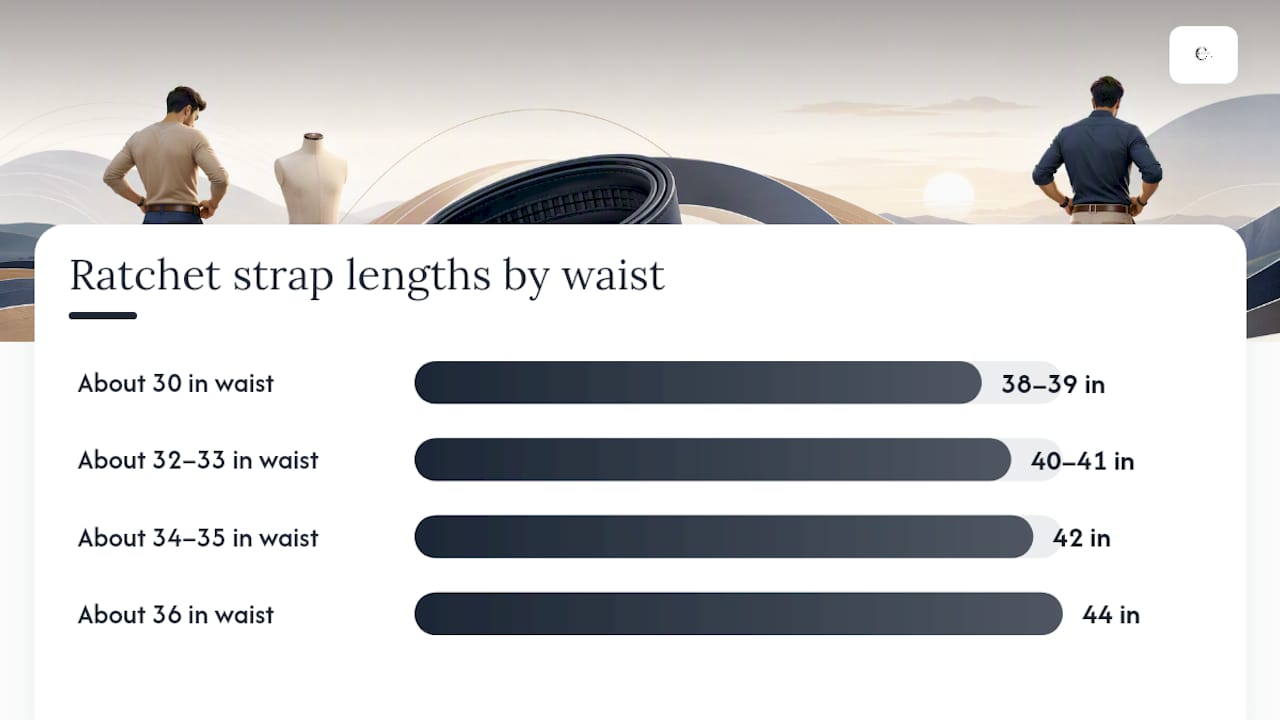
For ratchet belts, sizing works differently because these are sold by strap length, not a fixed hole position. Order the strap 6 to 8 inches longer than your waist measurement, then trim the excess at the buckle end after the first wear. That extra length isn’t waste. It’s what lets the ratchet mechanism’s fine adjustment actually do its job across seasons and weight fluctuations.
| Waist measurement | Common pin-buckle size | Ratchet strap length to order |
|---|---|---|
| About 30 in | About 32 in | About 38 to 39 in |
| About 32 to 33 in | About 36 in | About 40 to 41 in |
| About 34 to 35 in | About 38 in | About 42 in |
| About 36 in | About 40 in | About 44 in |
- Pin-buckle: waist measurement = order size.
- Ratchet: waist measurement + 6 to 8 inches = strap length to order.
- Always round up, never down, when the number falls between two listed sizes.
Belt Width and Style: Matching Loops and Outfit
Width gets ignored constantly, but a belt that’s technically the right length can still look wrong or fit poorly if it doesn’t match your loops. Measure your trouser belt loop width directly, then look for a strap that’s 1 to 2 millimeters narrower for smooth clearance without swimming inside the loop.
- Dress trousers typically take a medium width belt around 30 to 35 millimeters.
- Jeans and casual pants usually require a wider belt, roughly 38 to 40 millimeters.
- Slim women’s belts are often narrower, designed for smaller loops in the range commonly used for women’s styles.
Buckle size follows the same logic as strap width. A wider strap paired with a slimmer loop fights the fabric the whole day, while an oversized buckle on a dress belt throws off the visual proportion you’re going for. A medium width, sitting around 35 millimeters, tends to move between casual and slightly dressed-up outfits without looking out of place, which makes it the safer pick if you’re only buying one belt.
Pro Tip: If you wear both jeans and dress pants regularly, a 35mm belt in a dark leather tone is the closest thing to a universal fit for both wardrobes.
Checking the Fit Once the Belt Arrives
The moment the belt is out of the box, run this quick check before you decide whether to keep it.
- Fasten it at what would be your usual hole and confirm it lands at or near the middle hole. A properly sized belt fastens near the center, not at the very first or last one.
- Check the tail. It should pass through the first keeper loop cleanly, without flapping loose or straining to reach it.
- Look for a sharp V-shape pulling at the buckle. That’s a sign the belt is too tight, even if the hole placement seems fine.
If the belt runs too long on a pin-buckle style, tucking the tail neatly under the first keeper is the standard fix, though a ratchet belt can simply be trimmed shorter at the buckle end. Too short is harder to fix. A belt genuinely cannot be stretched, so ordering the next size up is the only real solution. High-rise trousers, thick denim, and plus-size fits all shift where the belt sits, so when in doubt, measure directly at the height you’ll actually wear it rather than assuming your usual size carries over.
Our Approach to Sizing Accuracy
CAS7M builds its fit guidance the same way across categories, whether that’s our dress size guide or our men’s suit sizing resource, because the underlying principle never changes: measure where the garment actually sits on your body, not where a label assumes it should.
That same logic carries over directly to belts on our site. Take your waist measurement using the loop method above, match it against the size listed on the product page, and size up if you land between two options. If the fit still misses once it arrives, our returns and exchange policy covers sizing adjustments, so getting it wrong on the first try isn’t the end of the process.
Different Sizing Standards Across Regions and Brands
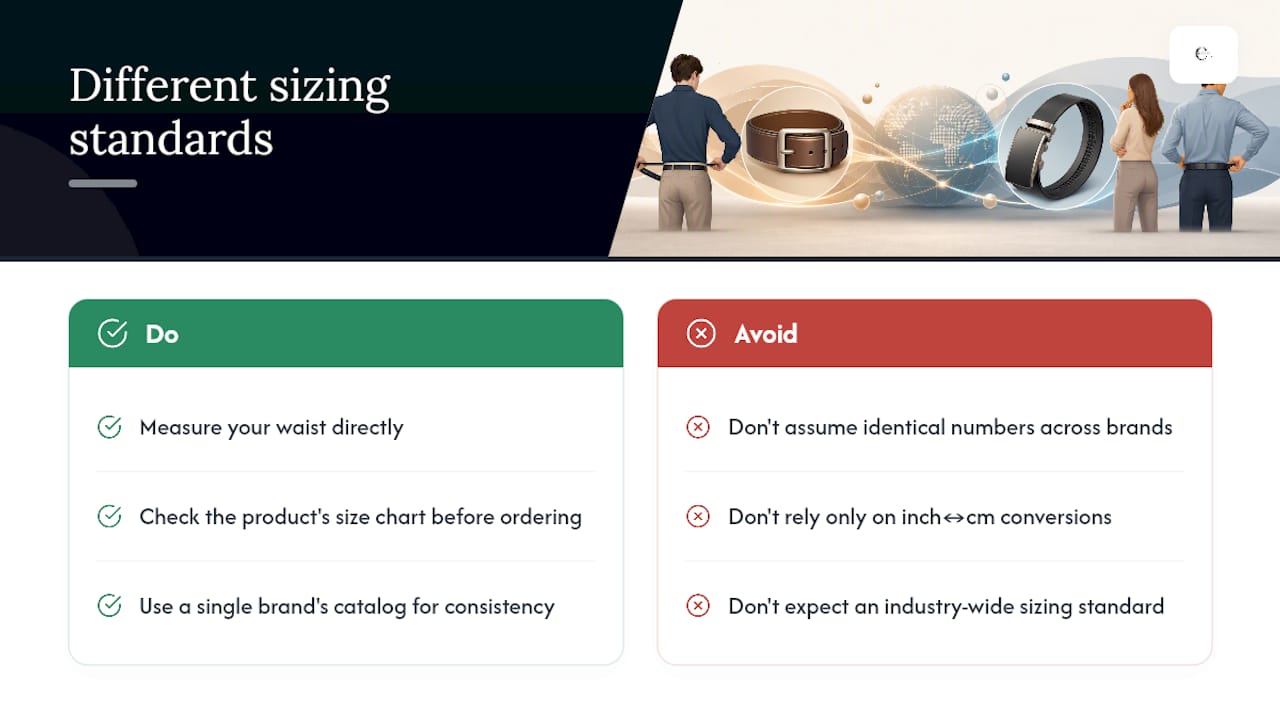
A size 36 belt from one brand doesn’t always match a size 36 from another, and that inconsistency trips up more shoppers than any single measuring mistake. American sizing typically runs on the waist-measurement-in-inches system, where a 36 is built to fasten near the middle hole at a 36 inch waist. European brands often size by centimeters and sometimes shift their numbering scale entirely, so a converted size can land a notch off from what the inch chart suggests.
Even within American labeling, there’s no universal regulator enforcing consistency the way there is for, say, food nutrition labels. One brand’s “size 34” might measure slim through the hole range, built for someone who wears a 32 or 33 waist, while another brand’s 34 runs generously. That’s the practical reason to lean on direct measurement over brand size labels whenever you’re buying something new. If you’re shopping across multiple brands, treat every size chart as a starting estimate rather than a guarantee, and check the specific size chart listed on that product page before you order. Consistency exists within a single brand’s own catalog far more reliably than it exists across the industry as a whole.
Adjusting Belt Size After Purchase
A belt that’s close but not quite right doesn’t always need to go back in the box. Punching a new hole is a straightforward fix for a pin-buckle belt that runs slightly long. A leather punch tool, sold at most hardware or shoe repair shops, lets you add a hole spaced evenly with the existing ones, ideally positioned so your usual fastening point lands at or near the middle of the strap.
Moving the hole works in the other direction too. If the belt runs a touch short and the last hole leaves the buckle uncomfortably tight, a cobbler can sometimes reposition the buckle attachment point to buy you an extra half inch, though this works better on thicker leather than on thin synthetic straps that tend to tear.
Ratchet belts skip this whole process. Trimming the strap at the buckle end with sharp scissors or a utility knife adjusts length in seconds, and the ratchet track handles the fine adjustment from there without any tools. What you can’t do, on either style, is add length to a belt that’s genuinely too small. Leather doesn’t stretch in any meaningful way, which is exactly why sizing up when you’re unsure beats sizing down and hoping for the best.
Our Take: Measure Twice, Guess Never
The pants-size-plus-two trick gets repeated so often that people treat it as gospel, but it’s a fallback, not a method. Vanity sizing on pants labels means that shortcut can miss by a full inch depending on the brand, and an inch is the difference between fastening comfortably at the middle hole and living on the last one with a tail that flaps past your first keeper.
What actually works is picking one of the two direct measurement methods, body at belt-loop height or an existing belt you trust, and treating everything else as a backup. The ratchet-versus-pin-buckle distinction trips up more shoppers than any other part of this process, mostly because people assume both systems size the same way. They don’t. A ratchet belt ordered at exact waist measurement will run short the moment you factor in the buckle mechanism itself.
If there’s one habit worth building, it’s rounding up when uncertain. A belt one size too big has five or six holes of room to adjust into. One size too small has nowhere to go.
— CAS7M
Shape Your Fit With a Waist Trainer That Actually Adjusts
Getting your belt size dialed in solves half the equation. If you’re also looking for support and shaping through the midsection, CAS7MFOCUS carries a corset waist trainer and tummy belt built for everyday wear under casual or fitted outfits, with an underbust cincher design that smooths the waistline without the bulk of a traditional shaper.
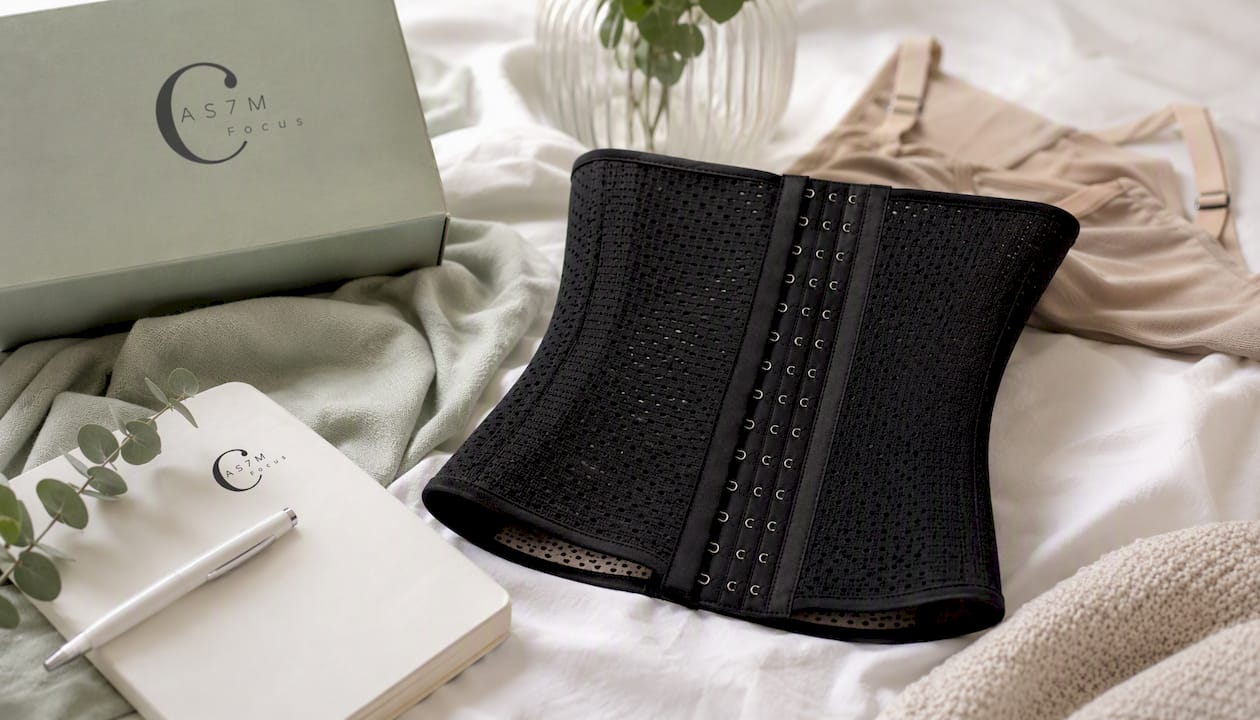
Sizing works on the same principle you just learned for belts: measure your natural waist circumference with a soft tape, then match that number against the product’s size chart rather than guessing from your regular clothing size. The hook-and-eye closures give a small adjustment range if you land between two measurements, so sizing up is the safer call if you’re on the fence. If the fit still isn’t right once it arrives, CAS7MFOCUS’s exchange policy covers size swaps, so check the waist trainer product page for current sizing details before you order.
Sources
- Determine belt size — wikiHow
- Belt Size Guide: Fit Checks for Better Sizing | Beltoria
- How to Choose a Belt | BeltUp
FAQ
What Size Belt Should I Buy for a 32 Inch Waist?
Order a size 34 to 36 pin-buckle belt, since the belt is meant to fasten near the middle hole rather than at the very end of the strap. For a ratchet belt, order a strap around 38 to 39 inches so there’s enough length to trim.
What Size Belt Should I Get for a 34 Inch Waist?
A size 36 to 38 pin-buckle belt typically fits a 34 inch waist comfortably at the center hole. If you’re buying a ratchet style, look for a strap length around 40 to 41 inches before trimming.
Is a Size 36 Belt Meant for a 36 Inch Waist?
Not exactly. Belt sizes usually run a couple of inches larger than the matching pants size so the strap fastens near the middle hole instead of the last one, meaning a size 36 belt often fits closer to a 33 or 34 inch waist.
How Long Should a Belt Be for a 28 Inch Waist?
A pin-buckle belt around size 30 to 32 can work for someone with a smaller waist. If measuring an existing belt that fits, the buckle fold to your usual hole should land near that size.

