


Cart
0
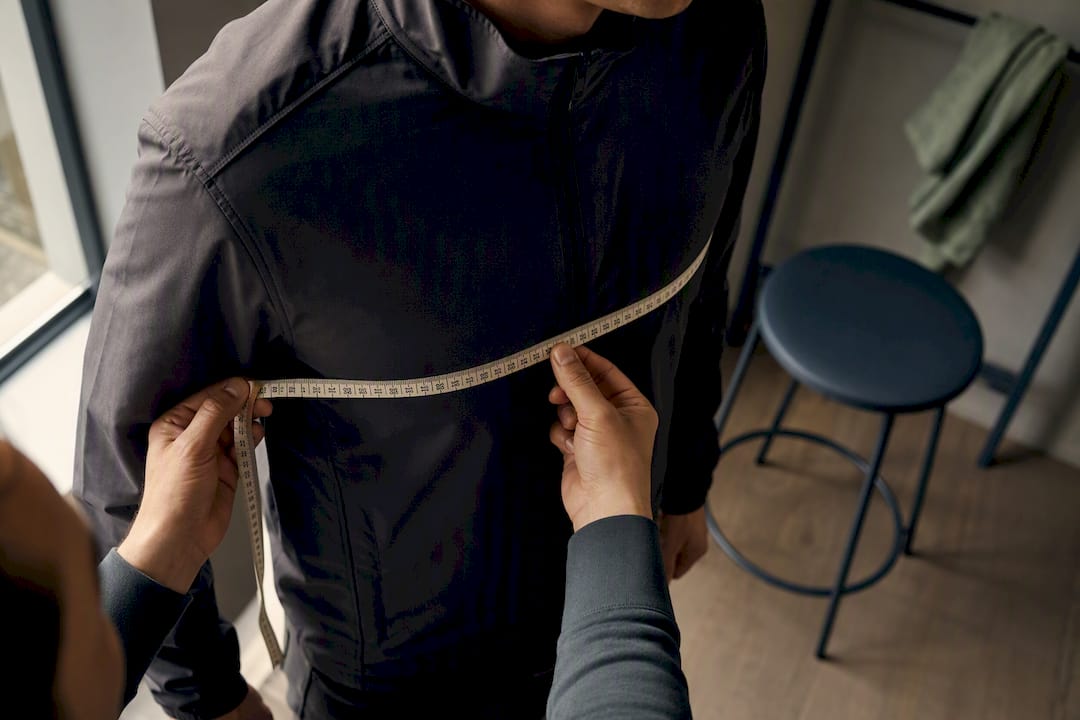
Take four measurements before you buy anything: chest, sleeve length from the base of your neck to your wrist, shoulder width, and waist or hip. Then compare those numbers directly against the garment measurements listed on the product page, not just the S/M/L label. Add extra room if you plan to layer underneath, and do a quick arm raise to check mobility before you check out.
TL;DR:
- Always measure your chest, shoulder width, sleeve length, and waist or hips before shopping for a jacket, not rely solely on size labels.
- Cross-reference your measurements with the brand’s specific garment dimensions, accounting for desired layering ease and fit purpose.
- Prioritize shoulder width in sizing, as it is the hardest to alter and critical for proper jacket fit.
- Check the garment’s actual measurements posted on product pages and compare them directly to your self-measured numbers for accurate fitting.
- Use your current well-fitting jacket’s measurements as a personal size reference for future online purchases.
Table of Contents
- Jacket Size Chart and Quick Conversions
- How to Measure Your Body for a Jacket
- Comparing Your Measurements With the Brand’s Size Chart
- Fit and Mobility Checks Before You Commit
- Layering Room and What Can Actually Be Altered
- How to Measure a Jacket That Already Fits
- Why This Guide Is Built for Fast, Accurate Online Shopping
- Understanding US, UK, EU, and Asian Jacket Sizing
- Decoding Regular, Slim, Tall, and Plus Size Labels
- Choosing Jacket Size by Intended Use
- What Actually Matters When You’re Sizing a Jacket Online
- Shop Jackets Sized Right the First Time
- Sources
- FAQ
Jacket Size Chart and Quick Conversions
Chest size is the number that decides almost everything else about how a jacket fits, so start there. The chart below gives a general starting point for translating chest inches into the numeric and letter sizes you’ll see on most product pages.
Treat this as a rough guide, not gospel. One brand’s medium runs closer to another’s small, especially once you cross between denim jackets, structured coats, and puffer styles. That’s why the smartest move is always cross-referencing your own chest measurement against the specific garment chart on the product you’re eyeing, which is exactly what the men’s suit size guide walks through for tailored pieces.
If a size chart lists centimeters instead of inches, the conversion is simple: multiply inches by 2.54 to get centimeters, or divide centimeters by 2.54 to get inches. A 40-inch chest converts to roughly 101.6 cm. Keep both numbers handy when you’re comparing US listings against European or Asian brands, since a mismatch here is one of the most common reasons for online jacket returns.
How to Measure Your Body for a Jacket
Grab a soft tape measure, stand naturally, and breathe normally. Here’s the order that gives you the most accurate numbers.
- Chest. Wrap the tape around the fullest part of your chest, under your arms and across your shoulder blades. Keep it level and snug against your body, but not compressing your ribs.
- Sleeve length. Start at the C7 vertebra, the bony bump at the base of your neck, and run the tape to your wrist bone with your elbow slightly bent. This bent-elbow method matters because measuring sleeve length this way stops sleeves from riding up once you actually move your arm.
- Shoulder width. Measure from the edge of one shoulder bone to the edge of the other, across your upper back. This one is nearly impossible to get right solo.
- Waist and hips. Measure your natural waist at the narrowest point, and your hips at the widest point below it, especially important for longer coats and overcoats that taper.
A few habits separate an accurate self-measurement from a guess:
- Measure over the layers you actually plan to wear under the jacket, not bare skin.
- Take each measurement twice and record both figures in inches and centimeters.
- Ask someone to help with the shoulder and sleeve measurements. A tape held at an angle by your own hand skews the number every time.
Comparing Your Measurements With the Brand’s Size Chart
Every jacket has two chest numbers hiding behind one size label: your body measurement and the garment’s actual measurement. The garment number is almost always larger, because a jacket needs breathing room, called ease, to close comfortably over your body.
Here’s the process that actually works:
- Find the product’s listed garment chest and sleeve measurements, not just the size name.
- Subtract your intended layering allowance from the garment chest figure to see how close it sits to your body measurement.
- Pick the size where the remaining gap matches how much extra room you want.
Pro Tip: If a product’s reviews repeatedly mention that it “runs small” or “runs large,” trust that pattern over the size chart. Real buyers wearing real bodies catch inconsistencies that a flat chart never will.
When you’re still unsure between two sizes, check the return policy before you buy. A flexible exchange window turns a guess into a low-risk test.
Fit and Mobility Checks Before You Commit
A jacket can look perfect on a hanger and still fail the moment you move. Run through this short checklist whenever you try one on, in a store or during an at-home fitting.
- Reach both arms forward and up, as if grabbing something off a high shelf. Watch for pulling across your upper back.
- Put on a backpack or bag with the jacket on to check for restriction across the shoulders.
- Sit down and cross your arms. If the back seam strains, the chest or shoulder size is too tight.
Shoulder seams matter more than almost any other fit point. The seam should sit right at the edge of your shoulder bone, not sliding down your arm or pulling up toward your neck, because tailors consistently report that shoulder adjustments are complex and rarely cost-effective compared to other alterations.
Pro Tip: Check sleeve length with your arms relaxed at your sides. Cuffs should end near your wrist bone, covering a bit of your shirt cuff without swallowing your hand.
Layering Room and What Can Actually Be Altered
How much extra room you need depends entirely on what’s going underneath. Outerwear fit guidance recommends these ease allowances as a baseline:
- Base layer only (t-shirt or light shirt): a small amount of ease.
- Light mid-layer (sweater or flannel): moderate ease.
- Heavy mid-layer (fleece or thick sweater): substantial ease.
Material changes the math too. Leather jackets typically build in around 4 inches of ease by design, and shearling pieces often need closer to 6 inches because the material itself adds bulk. Puffer jackets flip the logic. Since the insulation already adds visual and physical bulk, you may want to size down if you’re not layering heavily underneath, a nuance worth checking against choosing jackets for your lifestyle before you buy.
On alterations: sleeves and hems are easy fixes for most tailors. Shoulder width is not. Get that measurement right at the point of purchase, because it’s the one dimension you can’t reliably fix afterward.
How to Measure a Jacket That Already Fits
If you own a jacket you love, use it as your personal size chart for every future purchase.
- Lay the jacket flat and measure straight across from armpit seam to armpit seam, then double that number for your full chest measurement.
- Measure the sleeve from the center of the collar at the back of the neck down to the cuff.
- Measure shoulder seam to shoulder seam across the back.
- Measure jacket length from the base of the collar straight down to the hem.
Match these garment numbers directly against a new product’s listed measurements instead of relying on the size label. One detail worth confirming: some brands list a half-chest figure instead of the full circumference, so check which convention a brand uses before comparing. And keep style in mind. Using a tailored blazer’s measurements to shop for a puffer, or vice versa, will throw off the comparison even if the numbers look close on paper.
Why This Guide Is Built for Fast, Accurate Online Shopping
The online store carries a wide catalog of jackets, coats, and outerwear across men’s, women’s, and kids’ sizing, with product pages built around detailed photos and specific measurement fields rather than a single vague size label. That structure exists because sizing inconsistency is the single biggest source of friction in online apparel shopping, and a shopper who can see actual garment dimensions before checkout is a shopper who doesn’t need to guess.
This guide pulls from established measurement methods used across the fit and tailoring world, paired with practical layering math you can apply the same day you shop. It’s written to get you from tape measure to checkout in one sitting, with charts and steps you can actually use rather than abstract sizing theory.
Editors will continue refining this guide with additional fit notes and shopper feedback as more measurement data comes in.
Understanding US, UK, EU, and Asian Jacket Sizing
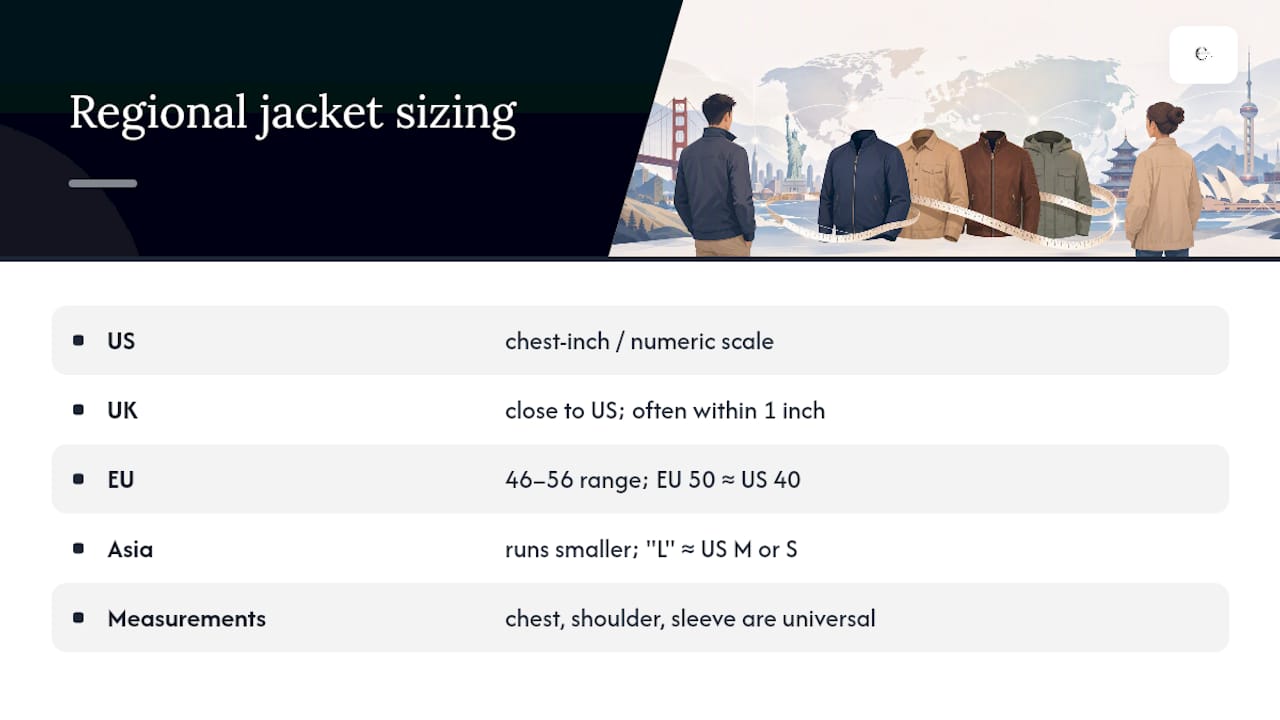
A US medium and a European medium are not the same jacket. US sizing typically runs on the chest-inch or numeric scale shown earlier, while UK sizing tracks closely with US numbers, often within an inch of each other for men’s jackets.
European sizing shifts to a different numbering system entirely, usually landing in the 46 to 56 range for men’s outerwear. A European size 50 roughly lines up with a US 40, though the exact match depends on the brand’s cut. Some European labels also run narrower through the shoulders and chest compared to US equivalents, a difference tailors and frequent international shoppers notice quickly.
Asian sizing, common on jackets sourced from manufacturers across the region, tends to run smaller across the chest, shoulders, and sleeve length than both US and European standards. A label reading “L” on an Asian-sized jacket can measure closer to a US medium or even small. This is precisely why chasing the size label across borders is a losing strategy. Your actual chest, shoulder, and sleeve measurements in inches or centimeters are the only numbers that translate cleanly across every standard, because a number stays consistent even when the letter next to it doesn’t.
When you’re shopping a size chart from any region, convert straight to your own measurements first, then find where you land on that specific chart. Skipping straight to matching letter sizes across brands is where most sizing mistakes happen.
Decoding Regular, Slim, Tall, and Plus Size Labels
Size labels carry more information than most shoppers realize, and reading them correctly saves a return trip to the mailbox.
Regular is the baseline cut a brand builds its chart around, assuming an average torso length and a standard shoulder-to-waist ratio for a given chest size. Slim fit trims the same chest measurement closer to the body through the waist and arms, built for a leaner frame rather than a smaller person. If your chest and waist measurements are close together, slim fit will likely feel snug through the midsection even at your correct chest size.
Tall sizing adds length, typically in the torso and sleeve, while keeping the chest measurement close to the regular version of that size. If your sleeve measurement consistently runs long compared to your chest size on the standard chart, a tall cut solves that mismatch without forcing you up a full size.
Plus size labels scale up chest, shoulder, and sleeve measurements proportionally rather than simply extending a regular cut. A well-built plus size jacket, like the plus size denim jacket coat or a plus size winter overcoat, adjusts shoulder width and sleeve proportion alongside the chest, not just the circumference. Always check the specific plus size chart rather than assuming it’s a regular chart shifted up two letters.
Choosing Jacket Size by Intended Use
The right size shifts depending on what the jacket needs to do for you.
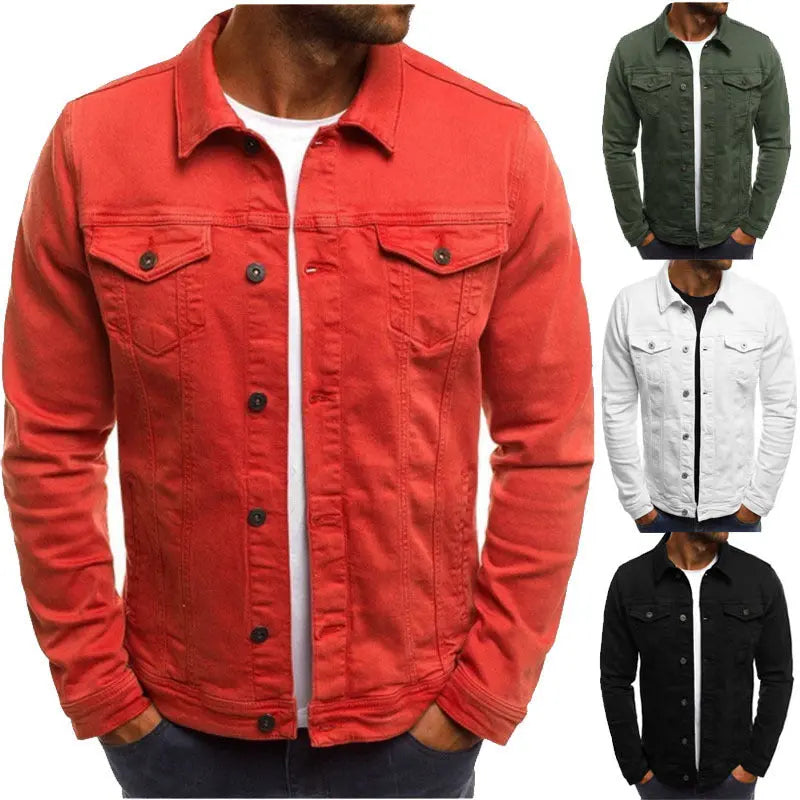
Formal jackets, blazers, and suit-style coats demand a closer fit. Minimal ease, a clean shoulder line, and sleeves that hit right at the wrist bone define a good formal fit. A denim button shirt jacket like this casual men’s denim jacket sits in more relaxed territory, built to layer over a t-shirt without the tailored precision a blazer needs.
Outdoor and performance jackets flip the priority toward mobility and layering room. If you’re hiking, skiing, or working outside, size up enough to fit a base layer and a mid-layer comfortably, and prioritize shoulder and underarm room over a trim silhouette. A jacket that looks slightly loose standing still often fits perfectly once you’re reaching, climbing, or carrying gear, a principle that applies just as much to technical sports apparel as it does to winter outerwear.
Everyday casual jackets sit in the middle. Enough room for a sweater underneath, but not so much room that the shoulders sag or the sleeves swallow your hands. When in doubt for casual wear, size for your most common layering scenario rather than the extremes.
What Actually Matters When You’re Sizing a Jacket Online
Most sizing advice online treats every measurement as equally important, and that’s the biggest weakness in the conventional wisdom. Shoulder width deserves more weight than chest circumference, waist measurement, or even sleeve length, because it’s the one dimension that’s genuinely difficult to fix after purchase. A slightly loose chest can be layered around. A slightly long sleeve can go to a tailor for a quick hem. A wrong shoulder size means the jacket never sits right, no matter what else you do to it.
The other overrated piece of advice is treating the size chart as the final word. Charts are averages built from a brand’s own pattern, not a guarantee for your specific proportions. The chest-inch conversion chart earlier in this guide is a genuinely useful starting point, but it’s a starting point precisely because letter sizes vary enough between brands that trusting them blindly leads to returns.
What should you prioritize first? Measure your shoulders accurately, even if it means asking someone for five minutes of help. Get that number right, layer around everything else, and use garment measurements over size labels every single time you shop.
— CAS7M
Shop Jackets Sized Right the First Time
This store lists real garment measurements on every jacket product page, not just a size label, so you can compare your own numbers against the actual chest, sleeve, and length figures instead of guessing what a medium means.
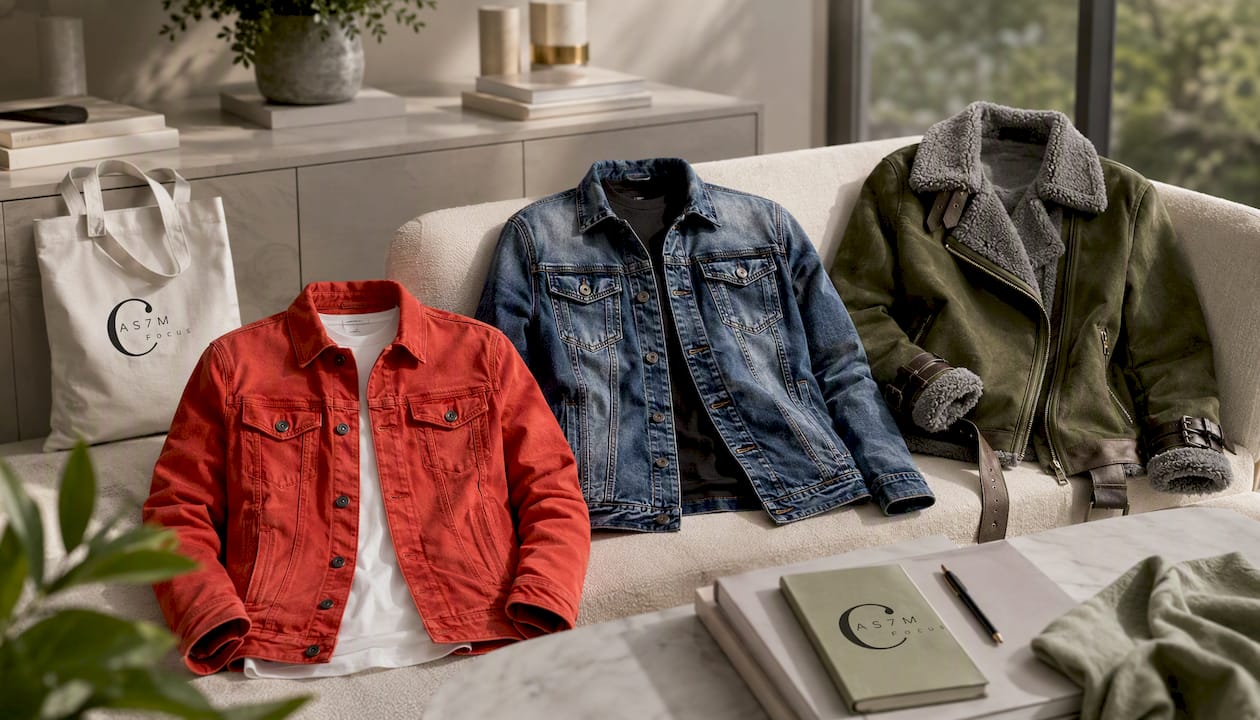
Browse the casual men’s denim button jacket for a relaxed everyday layer, the plus size denim jacket coat for a fuller cut built with proportional room through the chest and shoulders, or the women’s plus size winter overcoat for cold-weather layering with extra room built in for sweaters underneath. Each listing includes the garment measurements you need to match against your own chest, shoulder, and sleeve numbers from this guide. If the fit still misses once it arrives, check the return policy on the product page and exchange for the next size, no guesswork required. Take your measurements, pull up the size chart on the product you want, and order the size that actually matches your numbers.
Sources
- How to Measure Jacket Size: 15 Steps (with Pictures) - wikiHow
- Outerwear
- Jacket Measurement Guide | Tailor On Ten
FAQ
What size is a 42-inch jacket?
A chest size in the large range typically fits men’s jackets, though some brands split it between medium and large depending on their specific cut. Check the product’s garment chest measurement rather than relying on the label alone.
How do I know my size for a jacket?
Measure your chest at its fullest point, your sleeve from the base of your neck to your wrist with a slightly bent elbow, and your shoulder width seam to seam, then compare those numbers to the brand’s garment measurements rather than the S/M/L label.
Is a 42-inch chest a medium or large?
A chest measurement usually lands in the large category for most US men’s jackets, though it may be at the upper edge of medium for some slimmer-cut brands. When the chest falls between two sizes, prioritize shoulder fit and layering needs to decide.
Is a size 10 jacket considered medium or large?
In most women’s jacket size charts, a medium size typically fits, though the exact placement varies by brand and cut. Compare the brand’s specific chest and shoulder garment measurements against your own numbers to confirm before buying.
