


Cart
0
TL;DR:
- Your jacket size corresponds to your chest measurement rounded to the next even number, with the letter indicating height and torso proportion. Measuring your chest, waist, and height accurately helps determine the right suit size and fit, with adjustments possible mainly at the waist, sleeves, and hem. Most off-the-rack suits work best when shoulders fit properly, while tailors can fix other fit issues more easily than shoulder problems.
Your jacket size equals your chest measurement rounded to the next even number. The letter after that number — S, R, or L — comes from your height and torso proportion. Get those two things right, and the rest of suit sizing falls into place.
Three actions to take right now:
- Measure your chest at its fullest point (under the armpits, across the shoulder blades) and round any odd number up to the next even size.
- Record your natural waist measurement, taken just above the belly button, for trouser sizing.
- Note your height: under 5’7" typically points to Short, 5’7"–6’0" to Regular, and over 6’0" to Long.
Size up when:
- Your chest measurement lands on an odd number (41" → size 42)
- You have an athletic build with a broad chest relative to your waist
- You fall exactly between two sizes and plan to tailor
Size down only when a size up creates obvious excess fabric across the shoulders and chest with no way to tailor it in cleanly. Shoulders cannot be taken in easily, so this is the one area where a snug fit beats a loose one.
Table of Contents
- How to Measure Every Number You Need for a Suit
- US Suit Size Charts, S/R/L Codes, and International Conversions
- How a Suit Should Actually Fit
- How Suit Cut and Body Shape Change the Size You Should Choose
- Understanding the Drop and How to Pair Jacket and Trouser Sizes
- What Tailors Can Realistically Fix (and What They Can’t)
- Key Takeaways
- Why Measuring Accurately Is Worth the Extra Five Minutes
- Cas7m Has the Suits to Match Your Measurements
- FAQ
How to Measure Every Number You Need for a Suit
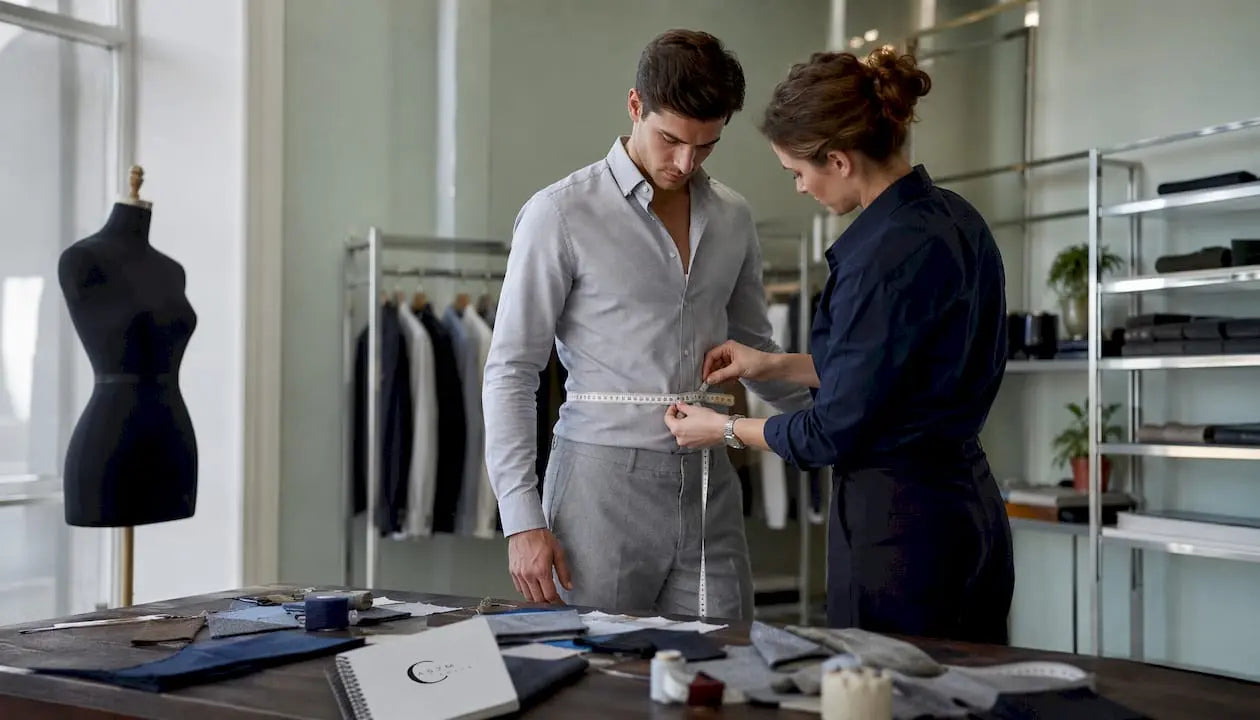
A complete fitting uses nine measurements: neck, shoulders, chest, waist, hips, bicep, sleeve length, jacket length, and inseam. Single numbers rarely capture body proportion, so take all of them before you shop.
What you need: a soft cloth tape measure, a thin t-shirt or underwear to measure in, and ideally a second person for shoulder and sleeve measurements. Stand naturally, breathe normally, and never suck in or puff out.
The measurements, step by step
-
Chest. Wrap the tape under your armpits and across the fullest part of your shoulder blades. Keep it level, breathe normally, and read the chest measurement at the fullest point. This is your primary jacket number.
-
Natural waist. Find the narrowest point of your torso, just above the belly button. This is higher than your beltline. Wrap the tape snugly but not tight. A common mistake is measuring at the beltline instead, which produces a number that is too low and too large.
-
Hips/seat. Stand with feet together and measure around the fullest part of your seat, roughly 7"–8" below your natural waist. This affects trouser fit more than jacket size.
-
Shoulders. Measure tip-to-tip across the upper back, from the edge of one shoulder to the other. Keep the tape flat across the back rather than following the curve of the shoulder. This ensures the jacket seam will sit at the shoulder edge rather than drooping down the arm.
-
Sleeve length. With your arm slightly bent, measure from the shoulder tip down to your wrist bone. A second person makes this significantly easier and more accurate.
-
Jacket length. Stand with your arms hanging naturally at your sides. The jacket hem should reach roughly to your knuckles. Use this knuckle test as a check rather than relying on height alone, because torso-to-leg proportion varies considerably between men of the same height.
-
Inseam. The most practical method: lay a well-fitting pair of trousers flat and measure from the crotch seam to the hem. This avoids awkward body measurements and gives a reliable number.
-
Neck. Wrap the tape around the base of your neck where a shirt collar would sit. Add half an inch for comfort.
-
Thigh. Measure around the fullest part of your thigh. Relevant for slim-fit trousers where thigh room is the first place fit breaks down.
Pro Tip: Measure twice and write every number down in one place — a phone note works perfectly. Update those numbers after any significant weight or fitness change, because a 15-pound shift can move you a full jacket size.
Technique rules to follow every time:
- Use a soft cloth tape, never a metal one
- Start the tape at zero and keep it level all the way around
- Apply the one-finger rule: the tape should be snug enough that you can slide one finger underneath it. Tighter than that compresses the measurement; looser inflates it
- Measure in a thin t-shirt or underwear, never over a thick sweater or jacket
- Take each measurement twice; if the numbers differ, take a third and use the consistent reading
US Suit Size Charts, S/R/L Codes, and International Conversions
How the US size number works
Your jacket size number comes directly from your chest measurement. If your chest is 41", you round up to 42. If it’s 42", you’re already there. US jacket sizes run in even numbers: 36, 38, 40, 42, 44, 46, and so on. The letter that follows tells you the jacket’s length category, which is based on height and torso proportion rather than chest alone.
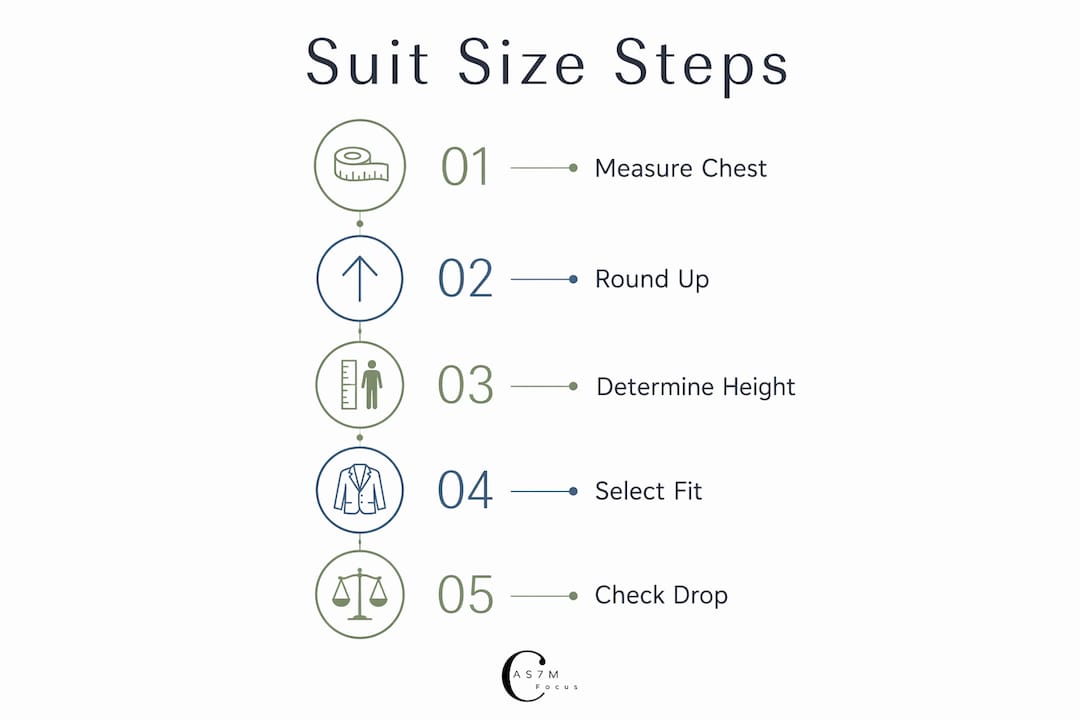
Most US retail size charts follow ASTM anthropometric baselines, which is why the height ranges below are consistent across most mainstream brands.
US men’s suit size chart
| Jacket Size | Chest (in) | Typical Trouser Waist (in) | Height: Short | Height: Regular | Height: Long |
|---|---|---|---|---|---|
| 36 | 36" | — | 5’4"–5’7" | 5’7"–6’0" | over 6’0" |
| 38 | 37"–38" | 32" | 5’4"–5’7" | 5’7"–6’0" | over 6’0" |
| 40 | 40" | — | 5’4"–5’7" | 5’7"–6’0" | over 6’0" |
| 42 | 41"–42" | 36" | 5’4"–5’7" | 5’7"–6’0" | over 6’0" |
| 44 | 43"–44" | 38" | 5’4"–5’7" | 5’7"–6’0" | over 6’0" |
| 46 | 46" | 40" | 5’4"–5’7" | 5’7"–6’0" | over 6’0" |
| — | 47"–—" | 42" | 5’4"–5’7" | 5’7"–6’0" | over 6’0" |
The trouser waist column assumes the standard 6" drop (chest minus waist). If your drop differs, see the drop section below.
Worked example
Your chest measures 41". Round up to 42. Your height is 5’9". That puts you in Regular. Your size is 42R. Your natural waist is 36", which matches the standard trouser pairing for a 42 jacket. Done.
International size conversions
A quick rule: add 10 to your US size to approximate the EU or Italian size. US 40 ≈ EU/IT 50. US 42 ≈ EU/IT 52. UK sizing typically matches US sizing directly, though some British brands label sizes differently at the extremes. Always confirm against the brand’s own chart, since exact centimeter values can shift by a size in either direction.
| US Size | EU/IT Size | UK Size | Chest (cm, approx.) |
|---|---|---|---|
| 36 | 46 | 36 | 92–93 cm |
| 38 | — | 38 | 97–98 cm |
| 40 | 50 | 40 | 102–103 cm |
| 42 | 52 | 42 | 107–108 cm |
| 44 | — | 44 | 112–113 cm |
| 46 | — | 46 | 117–118 cm |
To convert inches to centimeters, multiply by 2.—. A 42" chest equals roughly 107 cm.
How a Suit Should Actually Fit
Numbers get you close. Fit check gets you there. Use this checklist when you try on a suit or receive one at home.
Jacket fit checklist
- Shoulders first. The seam where the sleeve meets the jacket body should sit exactly at the edge of your shoulder, not drooping onto your arm and not pulling up toward your neck. This is the single most important fit point because shoulder alterations are expensive and structurally difficult.
- Chest closure. Button the jacket and check for an X-shaped pull across the front button. That means the chest is too tight. The lapels should lie flat with no gap.
- Waist suppression. A well-fitting jacket follows your torso’s natural shape. It should not balloon out at the sides or pull tight across the back.
- Sleeve length. About half an inch of shirt cuff should show below the jacket sleeve. If none shows, the sleeve is too long. If more than an inch shows, it’s too short.
- Jacket length. Use the knuckle test: arms hanging naturally, the jacket hem should reach your knuckles. Too short looks casual; too long looks dated.
- Back panel. No horizontal creases across the upper back (too tight) and no vertical bunching at the collar (collar gap, which means the jacket is too large in the chest or the back is cut wrong for your posture).
Pro Tip: Buy for the shoulders. If the shoulders fit, a tailor can adjust the waist, sleeves, and hem at reasonable cost. If the shoulders are wrong, no amount of tailoring will fix the silhouette without a major rework.
Trouser fit checklist
- Waist. You should be able to fit two fingers in the waistband comfortably. If you need a belt to hold them up, the waist is too large.
- Seat. No pulling or horizontal creases across the seat (too tight). No excess fabric sagging below the seat (too large).
- Thigh. Enough room to walk and sit without the fabric pulling across the front of the thigh.
-
Hem break. Three options, each with a different look:
- No break: hem hits the top of the shoe. Modern, clean, works well with slim-fit trousers.
- Slight break: a small fold of fabric at the shoe. Classic and versatile.
- Full break: fabric pools at the shoe. Traditional, less common in modern tailoring.
How Suit Cut and Body Shape Change the Size You Should Choose
The three main cuts
Slim fit leaves roughly 2"–3" of ease in the chest and very little through the waist and thigh. It works well on lean frames and creates a sharp, modern silhouette. If you have a muscular chest or thighs, slim fit will feel restrictive and pull at the seams.
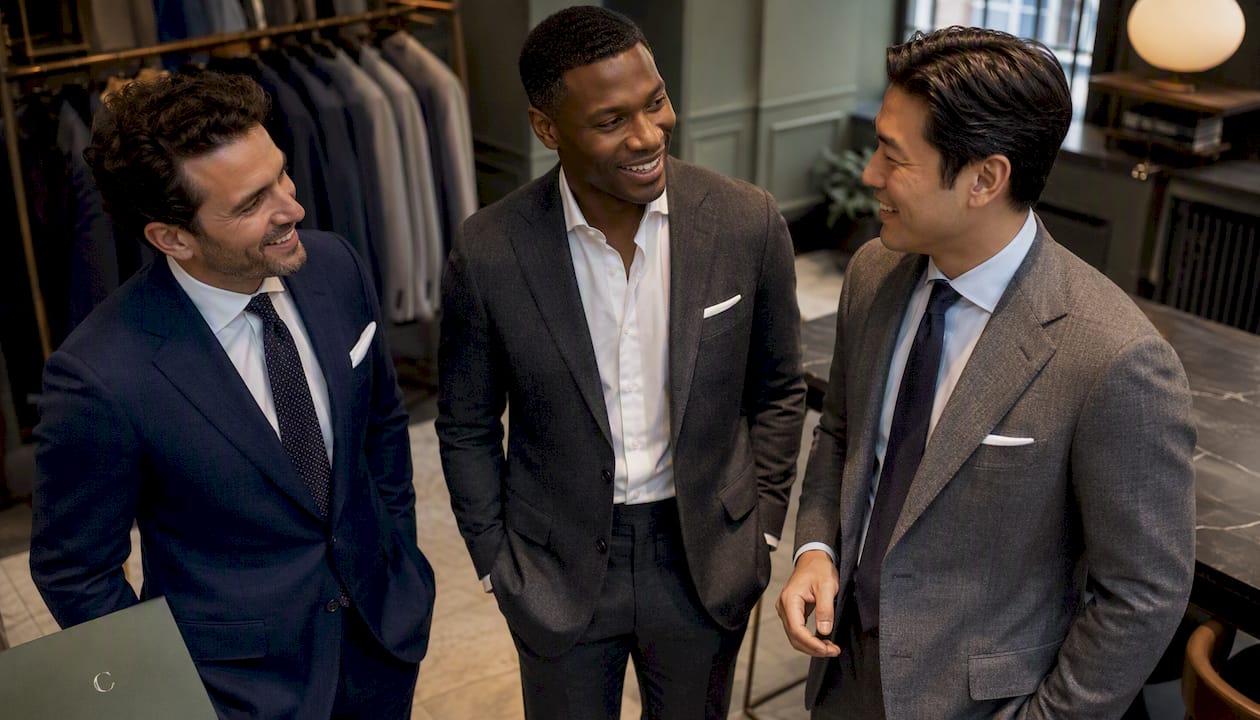
Modern fit (sometimes called regular fit) adds about 3"–4" of ease in the chest and a moderate taper through the waist. This is the most forgiving cut for a range of body types and the safest choice when buying online without trying on first.
Classic or traditional fit offers the most ease, typically 5" or more in the chest. It suits broader builds and men who prioritize comfort over a close silhouette. The trade-off is a less defined shape through the torso.
Matching cut to body shape
Athletic builds typically have a chest-to-waist drop larger than the standard 6". A 44" chest with a 36" waist gives you an 8" drop. Standard off-the-rack suits assume a 6" drop, so the jacket will fit the chest but feel loose at the waist. Modern or slim fit cuts tend to work better here, and a waist suppression alteration is often worth the cost.
Broader or rounder builds usually have a drop closer to 4" or less. A classic fit or relaxed cut accommodates this proportion without pulling across the back. Avoid slim fit entirely if your drop is under 4".
Short torso, long legs: choose a Short length even if your overall height suggests Regular. The knuckle test is more reliable than height charts for this proportion.
Broad shoulders, narrower chest: size for the shoulders and have the chest taken in slightly. Shoulder width is the hardest thing to alter, so it always wins the sizing decision.
When buying online, always compare the product’s stated fit category (slim, regular, relaxed) against your measurement targets. A “slim fit” 42 from one brand may have the same chest measurement as a “regular fit” 40 from another. Check the product’s actual measurements, not just the size label.
Understanding the Drop and How to Pair Jacket and Trouser Sizes
The drop is the difference between your jacket chest size and your trouser waist size. It tells you how well a standard suit pairing will work for your body.
-
Calculate your drop. Subtract your trouser waist from your jacket chest size. Example: 42 jacket, 36 waist = 6" drop.
-
Standard drop (~6"). Most off-the-rack suits are cut assuming a 6" drop. If your numbers match, the jacket and trousers that come together as a set will fit both measurements reasonably well.
-
Athletic drop (~8"). Chest 44, waist 36. The jacket fits the chest, but the matching trousers (size 38 waist in a standard set) will be too large. Buy the jacket for your chest and purchase separate trousers in your actual waist size, or have the trouser waist taken in.
-
Executive/portly drop (~4"). Chest 44, waist 40. The matching trousers will be too tight. Again, buy separates or size the trousers up and have them tailored at the waist.
-
Odd proportions: always size the jacket for shoulders and chest. The jacket body is harder to rework than trousers. Trouser alterations — waist, seat, hem, taper — are straightforward and relatively inexpensive.
-
When buying a two-piece set online, check whether the retailer offers separate jacket and trouser sizing. Cas7m’s men’s business-casual suit set and solid-colored business suit include detailed size charts so you can match your measurements to the right combination.
Pro Tip: If you’re between jacket sizes and your drop is non-standard, size the jacket up for shoulder and chest fit, then buy trousers to match your actual waist. Trouser alterations are faster and cheaper than jacket body work.
What Tailors Can Realistically Fix (and What They Can’t)
Buying off-the-rack and getting a few alterations done is the most practical path for most men. Knowing what’s easy, what’s expensive, and what’s impossible shapes smarter buying decisions.
Common alterations: cost and timeline
| Alteration | Typical US Cost | Typical Timeline |
|---|---|---|
| Trouser hem (shorten) | $10–$20 | 1–3 days |
| Trouser waist (take in or let out) | $15–$20 | 2–5 days |
| Trouser taper (slim the leg) | $20–$30 | 3–7 days |
| Jacket sleeve shorten | $20–$30 | 3–5 days |
| Jacket waist suppression | $30–$50 | 5–7 days |
| Jacket chest take-in | $50–$75 | 7 days |
| Shoulder adjustment | $75–$150 | 2–4 weeks |
For an off-the-rack suit bought for an event, budget $60–$150 for standard alterations (sleeves, hem, waist) that will make it look sharp quickly.
What tailors do well
Trouser work is fast and affordable. Shortening a hem, taking in the waist, and tapering the leg are all straightforward jobs that most tailors complete in under a week. Jacket waist suppression and sleeve shortening are also standard and reasonably priced.
What tailors struggle with
Shoulder width is the hardest alteration in tailoring. Narrowing or widening the shoulder seam requires dismantling the sleeve, adjusting the shoulder pad and canvas, and rebuilding the armhole. The cost reflects that complexity, and the result is rarely as clean as a suit that fit the shoulders from the start. Jacket length is similarly difficult: shortening a jacket requires moving the back vent, the lining, and all the bottom seams, which adds up quickly.
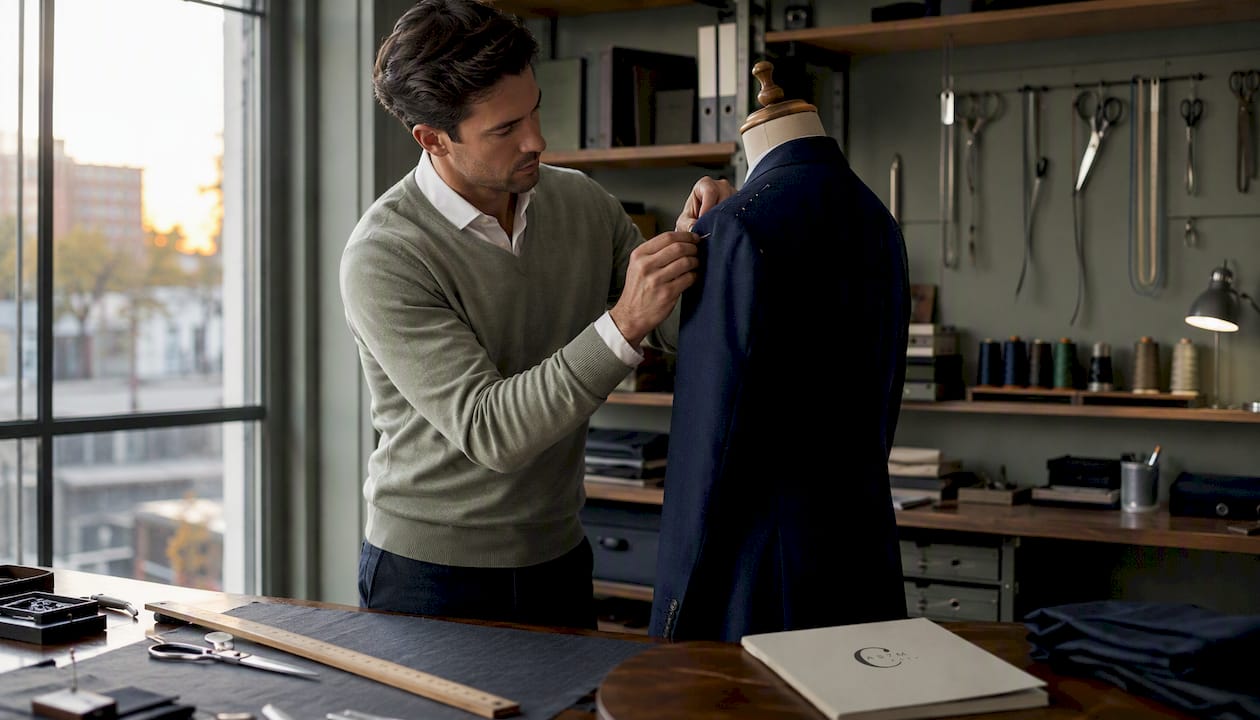
The practical rule: if the shoulders fit and the chest is close, buy it and tailor the rest. If the shoulders are off by more than half an inch in either direction, keep looking.
Off-the-rack vs. made-to-measure
Off-the-rack works well when your drop is close to 6" and your proportions are near the ASTM baseline. When your drop is 8" or more, or when you have a significantly non-standard torso-to-leg ratio, made-to-measure resolves those proportion mismatches without the alteration cost stacking up. For men who need a plus-size option, Cas7m’s men’s plus-size two-piece suit is built with extended chest and waist ranges to reduce the alteration burden from the start.
Key Takeaways
Getting your suit size right comes down to one accurate chest measurement, a height check for S/R/L, and knowing your drop so jacket and trouser sizes pair correctly.
| Point | Details |
|---|---|
| Chest drives jacket size | Measure at the fullest point and round any odd number up to the next even size. |
| Height sets S/R/L | Under 5’7" = Short; 5’7"–6’0" = Regular; over 6’0" = Long. |
| Standard drop is 6" | Chest minus waist; athletic builds run ~8", portly builds ~4" — plan separates if yours differs. |
| Shoulders are non-negotiable | Buy for shoulder fit first; waist, sleeves, and hem can all be tailored for $60–$150. |
| Cas7m suits for every build | The men’s business-casual and plus-size suit sets include detailed size charts to match your measurements directly. |
Why Measuring Accurately Is Worth the Extra Five Minutes
Most suit fit problems trace back to one moment: a measurement taken carelessly. A tape pulled too tight, a waist measured at the beltline instead of the natural waist, a chest number rounded down to avoid a larger size. Each small error compounds, and the result is a suit that needs more alterations than it should, or one that gets returned entirely.
The habit worth building is simple: keep a “suit size card” with your chest, waist, inseam, sleeve length, and height written down, along with the fit codes (S/R/L) and cut preferences you’ve confirmed work for your body. A phone note takes thirty seconds to update. Re-measure after any significant physique change, and certainly before buying a suit for an important event. Bodies shift, and a measurement from two years ago may no longer reflect your current fit.
The men who get suit fit right consistently are not the ones with the most fashion knowledge. They’re the ones who measured carefully once, wrote it down, and checked the shoulders before anything else.
Cas7m Has the Suits to Match Your Measurements
You’ve done the work: measurements recorded, drop calculated, fit preferences confirmed. Now it’s time to put those numbers to use. Cas7m offers a focused range of men’s suits built for real proportions and everyday confidence.
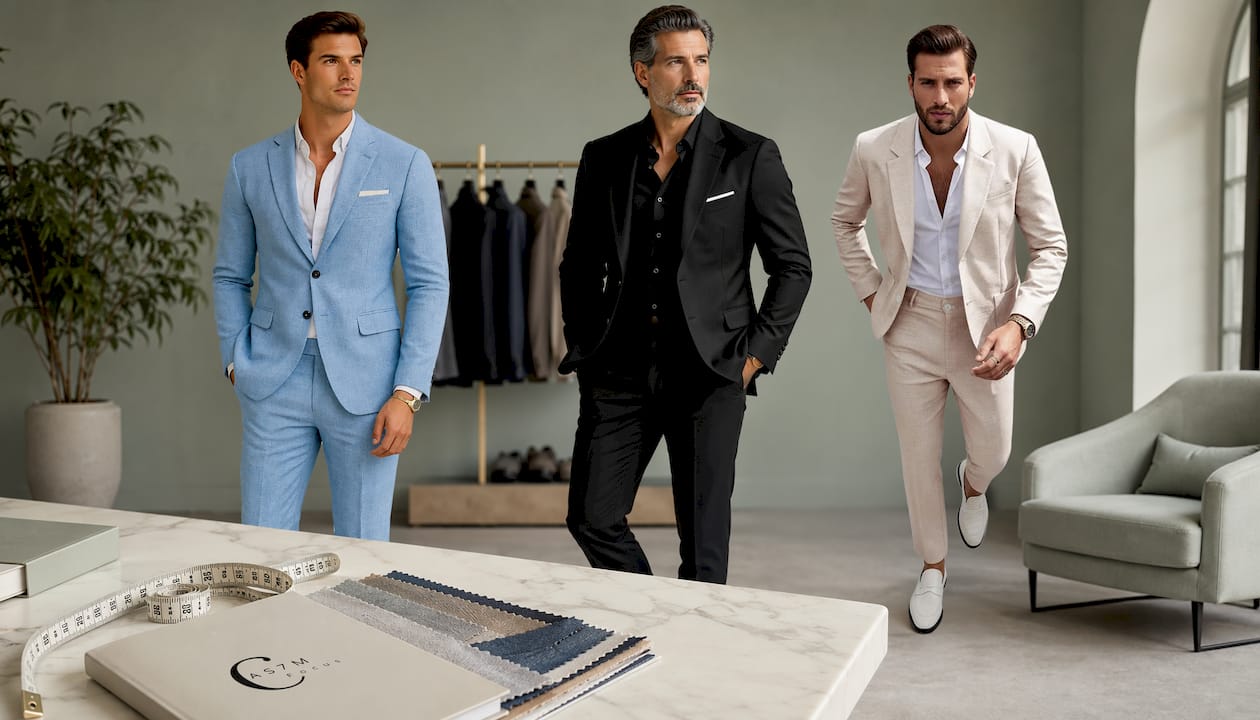
The solid-colored business suit set is a clean, versatile staple with a detailed size chart that maps directly to your chest and waist measurements. For a more relaxed everyday option, the business-casual two-piece set pairs modern styling with practical sizing guidance. And if your measurements fall in the extended range, the plus-size two-piece suit is cut with broader chest and waist proportions so the fit works from the start, not after three rounds of alterations.
Browse the full collection at cas7m.com and use your measurements to select the right size with confidence. If you’re unsure between two sizes, reach out to Cas7m’s sizing support before you order.
FAQ
What does a 42R suit size mean?
A 42R means the jacket is cut for a 41"–42" chest and a Regular torso length, suited for men roughly 5’7"–6’0" tall. The number is the chest size; the letter indicates jacket length.
How do I know my suit size without trying one on?
Measure your chest at its fullest point and round up to the next even number. That number is your jacket size. Check your height against the Short/Regular/Long guide to confirm the length code.
What size is a 44 in men’s suits?
A size 44 jacket fits a 43"–44" chest, typically with a standard trouser pairing of size 38 waist (assuming the standard 6" drop). It falls in the Large to XL range depending on the brand’s alpha sizing.
What does a 38 suit size mean?
A size 38 jacket is cut for a 37"–38" chest. It is a Small to Medium size in most US alpha-size charts, with a standard trouser pairing of size 32 waist.
When should I size up vs. size down in a suit?
Size up when your chest measurement is odd (round to the next even number), when you have an athletic build, or when you fall between sizes. Size down only when the larger size creates excess fabric across the shoulders that cannot be tailored in cleanly.

