


Chariot
0

A waterproof rating is a hydrostatic-head measurement, expressed in millimeters, that shows how much water pressure a fabric can resist before it leaks. That number only tells half the story. Read it alongside breathability (MVTR or RET) and construction details like taped seams and zipper protection, and you actually know whether a jacket will keep you dry or just look the part.
TL;DR:
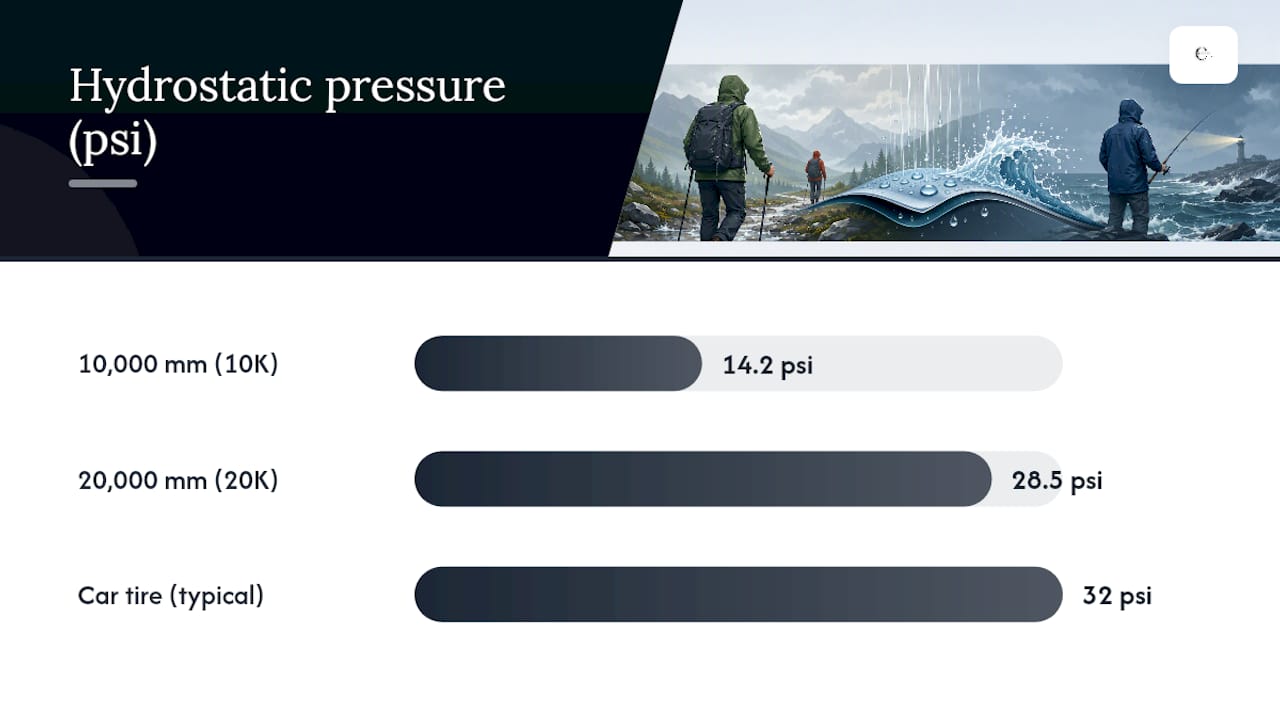
- A fabric rated 10,000mm can resist water pressure comparable to a 14.2 psi force, while 20,000mm can handle approximately 28.5 psi, doubling resistance.
- Hydrostatic head ratings are based on tests on small, new fabric swatches and do not account for seam, zipper, or garment construction weaknesses that cause leaks.
- For daily activities like commuting or errands, a 5,000 to 10,000mm rating with critical seam taping typically suffices, while 20,000mm or higher is needed for extended exposure or kneeling on wet ground.
- Breathability is measured by MVTR and RET, with RET under 13 providing better comparison across brands; high waterproof ratings often reduce internal comfort due to lower breathability.
- Proper garment performance depends on construction elements like sealed seams, waterproof zippers, and Reproofing DWR, which wear out over time and with washing.
Table of Contents
- Waterproof Ratings Explained: What the mm Number Measures
- How Waterproof Ratings Are Tested (And What Honest Labels Look Like)
- Understanding Waterproof Ratings by Band: What 5K, 10K, and 20K Actually Handle
- Breathability Ratings: Reading MVTR and RET Without Getting Confused
- What Actually Keeps You Dry: Materials, Membranes, and Seams
- Choosing the Right Waterproof Rating: A Shopping Checklist
- The Fashion Shopper’s Take on Waterproof Specs
- Rain-Ready Styles That Don’t Sacrifice Fit
- Sources
- FAQ
Waterproof Ratings Explained: What the mm Number Measures
The number on a hangtag, usually something like “10,000mm” or “20K,” comes from a test called hydrostatic head. A lab clamps a swatch of fabric under a tube of water and slowly raises the water level until moisture starts to seep through. Whatever height the water column reaches at that failure point, measured in millimeters, becomes the fabric’s rating.
That’s it. That’s the whole test. A fabric rated 10,000mm held back a column of water 10 meters tall before it gave way. The “K” shorthand you’ll see on outdoor labels (5K, 10K, 20K) is just a stand in for thousands of millimeters.
Numbers like these are abstract until you convert them into something physical. A hydrostatic head rating around 10,000mm equals roughly 98 kilopascals of pressure, or about 14.2 psi, while a 20,000mm rating works out to around 196 kPa, or 28.5 psi. For comparison, a car tire typically sits around 32 psi. That means a well-rated rain shell is holding back pressure in the same ballpark as a properly inflated tire, just applied differently.
Statistic Callout: Doubling a fabric’s mm rating from 10K to 20K roughly doubles the pressure it can resist, from about 14.2 psi to 28.5 psi. That gap matters most when you’re kneeling, sitting, or carrying weight, not when you’re just walking around in drizzle.
Here’s the part shoppers miss most often: this test happens on a small, flat, brand-new fabric swatch in a controlled lab, not on a finished garment. A finished jacket has seams, zippers, pockets, and stitching, and every one of those is a potential weak point the swatch test never accounts for. The mm number describes the fabric itself, not the garment you’re about to zip up.
A few things worth remembering about that number:
- It measures fabric performance in a lab, not garment performance in the rain.
- Higher isn’t automatically better if the construction around it is weak.
- The rating degrades with wear, abrasion, and age, even if the label never changes.
- It says nothing about how the garment breathes, which is a separate spec entirely.
How Waterproof Ratings Are Tested (And What Honest Labels Look Like)
Two test standards dominate the industry: ISO 811 and its American counterpart, AATCC TM127. Both use the same basic hydrostatic head method, applying increasing water pressure to a clamped fabric sample until three drops of water appear on the underside. ISO 811 is the internationally recognized version, and most reputable outdoor brands cite one of these two standards directly on spec sheets, even if it never makes it to the retail tag.
A trustworthy product listing pairs the mm figure with the test standard used to get it. “10,000mm hydrostatic head, tested to ISO 811” tells you something verifiable. “Waterproof” with no number and no method tells you almost nothing, because “waterproof” isn’t a regulated term in apparel the way it is in some other product categories.
A few practical limits worth knowing before you trust any number blindly:
- These tests use fresh water in a lab, not the mix of rain, mud, and abrasion a garment sees outdoors.
- A rating is measured on new fabric. Wear, washing, and UV exposure lower real-world performance over time.
- Brands don’t always disclose which standard they used, which makes cross-brand comparisons shaky.
You’ll also see waterproof claims on enclosed items like phone cases, watches, and bags, and those use a completely different system: IP codes. An IPX7 rating means an item can survive temporary immersion to about 1 meter for 30 minutes, while IPX8 covers deeper or longer immersion at whatever depth the manufacturer specifies. IP ratings and hydrostatic head mm ratings measure fundamentally different things (sealed enclosures versus porous fabric), so never assume one number translates to the other.
Understanding Waterproof Ratings by Band: What 5K, 10K, and 20K Actually Handle
Numbers only matter once you attach them to real situations. Here’s how the common bands break down in practice.
- Under 1,500mm counts as water resistant, not waterproof. It’ll shrug off light mist or a quick dash to the car, and that’s about it.
- 3,000mm to 5,000mm handles short exposure to light, steady rain. Fine for a walk to the bus stop, not fine for standing in a downpour.
- 10,000mm is the widely used working floor for calling a jacket genuinely waterproof for everyday outdoor use. It handles sustained rain, wind driven moisture, and normal daily pressure from walking and sitting.
- 20,000mm and above is built for sustained exposure under real physical load: kneeling on wet ground, a loaded backpack pressing straps into wet fabric, or extended time in heavy weather.
Pressure explains why the higher bands matter more than they seem to on paper. Sitting on a wet bench or kneeling on saturated ground concentrates your body weight onto a small patch of fabric, generating far more localized pressure than standing upright in the rain ever does. That concentrated pressure is why load-bearing spots like backpack straps and seat areas benefit most from a higher mm rating, even on a garment that otherwise sees light use.
Pro Tip: If you’re choosing between two similar jackets and one is rated 10,000mm and the other 15,000mm, ask yourself whether you’ll be sitting, kneeling, or carrying weight in the rain. If the answer is mostly “just walking,” the 10,000mm option will likely feel identical in daily use.
For most shoppers, a sensible default looks like this: commuters and everyday errands are covered at 5,000 to 10,000mm, all-day rain exposure calls for 10,000 to 15,000mm, and genuinely rough, high-exposure conditions justify pushing toward 20,000mm or higher.
Breathability Ratings: Reading MVTR and RET Without Getting Confused
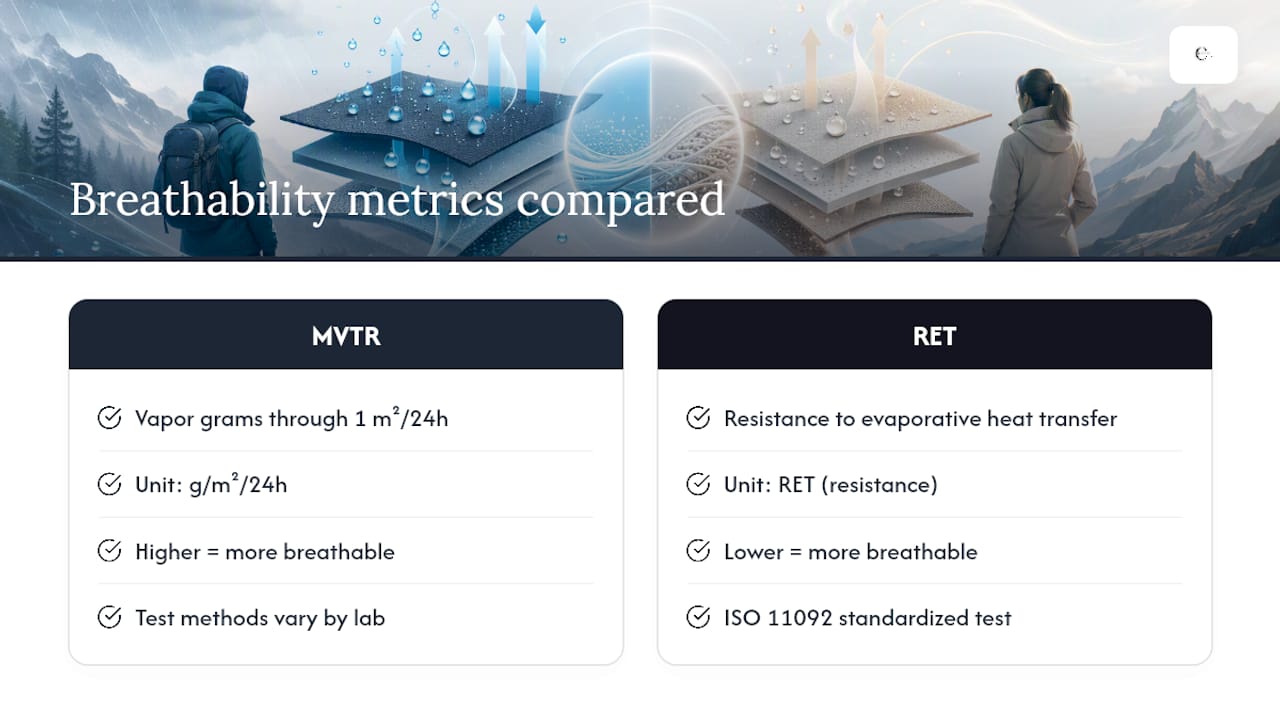
A waterproof rating tells you nothing about whether you’ll be dry from sweat instead of rain, and that’s where breathability metrics come in. Two systems dominate: MVTR and RET, and they run in opposite directions, which trips up a lot of shoppers.
MVTR (Moisture Vapor Transmission Rate) measures grams of water vapor that pass through a square meter of fabric in 24 hours. Higher MVTR means more breathable fabric. RET (Resistance to Evaporative Heat Transfer) measures the opposite: how much a fabric resists letting vapor escape. Lower RET means more breathable fabric, and RET is measured under ISO 11092, which produces more consistent, comparable results across different labs and brands than MVTR does.
Statistic Callout: Because MVTR test methods vary between labs and manufacturers, two jackets both claiming “20,000 g/m²/24h” aren’t necessarily equally breathable. RET is the more reliable number for actually comparing breathability across brands, since it’s tied to a single standardized test.
As a rough guide, RET values under 6 indicate very breathable fabric suited to high-output activity, RET between 6 and 13 works for moderate activity, and anything above 13 leans toward low breathability, better suited to low-output wear like standing around at a bus stop or running errands.
There’s an inherent trade-off here: making a fabric more waterproof by tightening its pore structure or adding coating layers tends to reduce how easily vapor escapes. Engineered membranes attempt to solve this by allowing vapor molecules through microscopic pores too small for liquid water to pass. That’s a genuine improvement over basic coated fabrics, though no membrane fully eliminates the trade-off. If a garment feels clammy inside despite being rated waterproof, breathability, not the mm number, is usually the culprit.
What Actually Keeps You Dry: Materials, Membranes, and Seams
The mm rating gets all the attention, but construction is often what decides whether you stay dry in practice. Four elements do most of the work.
DWR (Durable Water Repellent) is the coating that makes water bead up and roll off fabric instead of soaking in. It’s the reason a new rain jacket looks like it’s shedding water in sheets. DWR wears off with abrasion, dirt, and washing, and once it fails, fabric “wets out,” meaning water saturates the outer layer and the jacket starts feeling heavy and cold, even if the waterproof membrane underneath is still doing its job. Reproofing sprays and washes restore the beading effect and can extend a garment’s usable life well past the point most people would give up on it.
Membrane versus coating is a construction choice, not a marketing term. Membranes are thin, engineered layers laminated to the fabric that block liquid water while allowing vapor through. Coatings are liquid polymer applied directly to fabric, generally cheaper to produce and reasonably waterproof, but usually less breathable and less durable over time than a laminated membrane.
Seams and zippers are where waterproof garments most often fail in the real world. A perfectly rated fabric with unsealed stitch holes will leak at every seam line. Fully taped seams cover every stitch, while “critical seam” construction only tapes high-exposure areas like shoulders and the hood. Zippers need dedicated waterproof coil zippers or a storm flap to block water at the closure.
- Reproof DWR every few washes, especially on jackets you rely on for wet commutes.
- Check the tag or product page for “fully taped seams” rather than assuming all seams are sealed.
- Avoid high-heat drying, which can damage membranes and degrade coatings faster than air drying.
Pro Tip: A quick way to spot a wetting-out jacket versus a genuine leak: if water is beading and rolling off but the surface fabric feels damp and heavy, that’s a DWR failure, not a rating failure. Reproofing usually fixes it in one treatment.
Choosing the Right Waterproof Rating: A Shopping Checklist
Before buying anything labeled waterproof, run through four quick questions: How long will you actually be exposed? Will you be sitting, kneeling, or carrying weight that adds pressure? How intense is the activity, meaning how much heat and sweat will you generate? And what’s the cost of getting caught unprepared, a minor inconvenience or a genuinely miserable day?
- Short exposure, low pressure, casual activity (commuting, errands, waiting for a bus) fits comfortably at 5,000 to 10,000mm with moderate breathability and critical seam taping.
- All-day exposure, moderate pressure (a full day outdoors, sitting on damp surfaces) calls for 10,000 to 15,000mm, fully taped seams, and RET under 13.
- Extended exposure, high pressure, high output (backpacking, heavy activity in sustained rain) justifies 20,000mm or higher, fully taped seams, waterproof zippers, and RET under 9.
Watch for red flags on product pages: the word “waterproof” with no mm number or test standard attached, seam construction that’s never mentioned at all, or vague phrases like “weather resistant technology” that don’t specify what that technology actually is. A listing that names ISO 811 or AATCC TM127 directly is telling you something concrete. One that doesn’t is asking you to take it on faith.
| Trip type | Recommended mm | Breathability target | Seam construction |
|---|---|---|---|
| Commuting / errands | 5,000 to 10,000mm | Moderate (RET 13 to 20) | Critical seams taped |
| All-day rain exposure | 10,000 to 15,000mm | Good (RET 9 to 13) | Fully taped seams |
| High-output / expedition use | 20,000mm+ | Very good (RET under 9) | Fully taped seams, waterproof zips |
The Fashion Shopper’s Take on Waterproof Specs
Most people reading a waterproof label aren’t planning a summit attempt. They want a hoodie or jacket that survives a rainy commute and still looks good doing it, and that changes what actually matters. For everyday wear, a solid DWR finish paired with taped critical seams often does more real-world work than chasing a 20K rating built for expedition gear you’ll never need.
Match the rating to your actual weather, not your aspirations, and check our guide to choosing outerwear by temperature and activity before you buy. Always check the care label. DWR finishes and membranes both lose performance if you wash them wrong.
— CAS7M
Rain-Ready Styles That Don’t Sacrifice Fit
Once you know what to look for, shopping gets a lot faster. There are outerwear options built for real weather without giving up fit and style, addressing a common gap in technical rainwear.

For layered protection on wet days, the detachable hooded denim jacket gives you a removable hood you can adapt to the forecast, while the boys jacket covers kids’ outerwear needs with the same attention to comfortable, everyday fit. Before you buy any rain-ready piece anywhere, always check the product description for mentioned seam treatment, DWR finish, or listed water resistance specs. If a listing does not spell those out, ask before you assume.
Browse the full outerwear lineup on the CAS7MFOCUS storefront and filter by what the season actually demands. New arrivals drop regularly, and checking back before the weather turns means you’re never scrambling for a jacket once the forecast changes.
Sources
For deeper technical reading, consult ISO 811 hydrostatic head test documentation, ISO 11092 breathability standards, and IP code definitions for enclosed waterproof items like phone cases and PVD-coated accessories.
- IP code — Wikipedia
- Waterproof Rating Explained: The mm Guide for Brands Sourcing Jackets
- Waterproof & breathability ratings explained | INOV8 EU
FAQ
Is IP67 or IP68 Better for Waterproofing?
IPX8 offers stronger protection than IPX7 because it covers immersion beyond 1 meter at a depth the manufacturer specifies, while IPX7 only certifies temporary immersion to 1 meter for 30 minutes. Neither rating applies to fabric garments, since IP codes are built for enclosed items like phones and cases, not porous textiles.
Is a 20,000mm Waterproof Rating as Good as Gore-Tex?
A 20,000mm hydrostatic head rating describes raw fabric pressure resistance, while Gore-Tex is a branded membrane technology focused on combining waterproofing with breathability. A 20,000mm fabric can perform very well for heavy exposure, but comparing it fairly to a branded membrane requires also checking its breathability rating (RET), not just the mm number alone.
What Does IP69 Waterproof Mean?
IPX5 and IPX6 indicate protection against high-pressure water jets, typically used for industrial or automotive equipment rather than consumer apparel. These have no direct relationship to hydrostatic head ratings used on clothing, since the two systems test completely different scenarios.
Is 20,000mm a Good Waterproof Rating?
Yes, 20,000mm sits in the heavy-duty range, suited to sustained exposure and high-pressure situations like kneeling on wet ground or carrying a loaded pack in rain. For most everyday and commuting use, 10,000mm already meets the common working threshold for calling a jacket genuinely waterproof, so 20,000mm is often more capability than casual wear requires.
What’s the Difference Between Water Resistant and Waterproof?
Water resistant fabric, generally under 1,500mm hydrostatic head, handles light moisture like mist or a brief drizzle but soaks through under sustained rain. Waterproof fabric, typically rated 10,000mm or higher with sealed seams and proper closures, holds up under continuous exposure and applied pressure.

